Classes begin this week at Apex Theatre Studio! by Raines Carr

Acting One (12 weeks) (1/11/18-4/11/18) Ages 12-17

Wednesdays 5:15 p.m. -6:30 p.m.  

In this entry level class,  young artists will develop who they are under the stage lights.  Key concepts include establishing honesty onstage,  developing spontaneity in character work and presenting your “best self” and continuing to energize the space. The class will perform monologues for their final presentations in the spring.


Acting for the Camera (12 weeks) (1/11/18-4/11/18) Ages 12-17

Wednesday 6:30 p.m. -7:45 p.m.

Is there a difference between stage performance and camera acting? Absolutely. This class defines the fundamentals of working in film, television and commercials.

Participants will develop a polished on-camera audition piece to use for submission purposes.

REVIEW: Rich layers bring depth to Tennessee Williams' play by Raines Carr

Original Article here.

By Mark Hughes Cobb Staff Writer

Trained ears recognize Mozart before it's back-announced on public radio, even from a previously unheard work. Common strains and refrains, themes and variations, run through an artist's oeuvre, complications rising from the inherent complexity of looking inward, then turning those discoveries to light and life.

Picture a play in 20th-century Deep South, with language rich and heady as magnolias in bloom, a domineering mother who overruns a sensitive young woman, throwing blocks between her and a decent gentleman caller, tied up in an overly perfumed bow of oppressive societal mores, and put your money on Tennessee Williams.

It isn't Laura, Blanche nor Maggie the Cat at heart in "The Eccentricities of a Nightingale," though streams of each travel through Alma Winemiller (Chelsea Reynolds), DNA strands peeled apart, then rewound into yet another complex heroine.

Alma's more demanding than Laura, less damaged than Blanhe, honest and direct as Williams' stronger maternal characters. She's vivid as a neon sign, flickering maybe, but glowing, expressive. Alma craves more, more, more; the heady rush of desire overtakes and ironically pushes away what she'd pull near. Her outer world will always disappoint, never vibrate at her frequency, even when she forces fluttery energy outward. A church and wedding singer, she's mocked for overly generous gestures, extremity of expressions, but in turn, can't fathom how a body can just hold still.

She's too much for most, including an otherwise kind father (William Green), who wonders if she could just tamp it down, keep her hands from flying away; he's overwhelmed dealing with Alma's much-needier mother (Kaki Clements). She's persona non grata to Mrs. Buchanan (Deborah Parker), mother of young doctor John (Ross Birdsong), the neighbor Alma fixates on from her bedroom window, which peeks into his. John's one of the few who accepts her oddities, and even helps smooth her edges, some. He's near perfect, kind, open-hearted ... all but for that mama's boy thing.

Momzilla's buffing his societal shine, talking up a dream wife, a perfect life. She steers John so severely away from Alma, rebellion's fuels a spark. There is something between John and Alma, whether a simple, open friendship, or opposites attracting, his grace and passivity enlivened by her fire and abandon. It's a testament to both writing and performances that it's unclear exactly what Alma ultimately wants: Love? Lust? Companionship? Does she consciously choose John for the balance he'd bring? Even as Alma's brutal honesty runs throughout, there's a compelling, rich ambivalence to work's ending.

Director Raines Carr feels this material deeply, and brought that out with his cast and crew. Williams was too adept to create black-and-white characters, but he may as well have shone a perpetual spotlight on Alma, beautifully played by Reynolds in a gem of actor alchemy that seems more like possession than interpretation. There are no seams. The only thing showing is Alma, in all her speed-rapping frenzy, embodying the heartbreak that, in this tiny, backwards town, her wit, brilliance and vitality will never find its equal. And yet she still feverishly persists.

Birdsong charms as John, nicely balanced, nuanced self-effacing boy-man, still finding his footing, secure enough to let Ma win for now, because he's playing a long game. The only thing wrong with John isn't the actor's fault: Who would choose dull respectability over a shooting star?

Green and Parker carry the paternal roles with pro skill, shading less-understanding moments with generous clarity of heart: They mean well, and are doing what they think best. Clements inhabits with unnerving ease the disturbed woman who shows the dangers of an Alma let entirely loose. Each of the supporting cast finds his or her niche as Alma's fellow oddballs, a kind of club, a bulwark against the world.

There's lovely original music in the show, some recorded, some sung live, written by Raphael Crystal, and fitting the hothouse flower motif lovingly. The set's a ghostly, silvery-blue-white work by Charles Moncrief that can suggest a wintry New Orleans cemetery, or a chilly interior, with just a few shifts of furniture, or light shifts and shades by Genarro Seno. Cecilia Gutierrez aptly dresses the cast in clothing that makes you forget costumes, despite the period ambiance.

After Theatre Tuscaloosa's "The Real Queen of Hearts Ain't Even Pretty," which shares with "Nightingale" some Southern flavors and feels, it's yet another craftily composed and deftly executed work that rewards attention. It's all there for you, but the "it" can be found in layers.

UA play embraces the unconventional by Raines Carr

Original article here.

By Ellen Johnson, Special to The Tuscaloosa News

Eccentric characters can steal a story. As in the case of tormented Blanche from "A Streetcar Named Desire," the louche, prancing Captain Jack Sparrow in the "Pirates of the Caribbean" movies, or Heath Ledger's maniacal Joker in "Dark Knight," audiences often feel drawn to the broken, the weird and the wacky.

"Even as an outcast, we can still have a full life and a fully realized life if we embrace who we are," said Raines Carr, a third-year master of fine art directing student, and director of the University of Alabama Department of Theatre and Dance production of Tennessee Williams' "The Eccentricities of a Nightingale."

The offbeat outcast is Alma, an overly passionate Episcopalian priest's daughter living in small-town Mississippi, just before World War I. Like others of Williams characters, Alma finds her intensity and her out-sized sensitivities push her to the outskirts of society, as she struggles to win the heart of a neighbor, a young doctor she's loved her whole life.

The cast of UA students has been rehearsing in the Allen Bales Theatre since the first week of spring semester classes. The script was based on Williams' 1948 play, "Summer and Smoke," which the writer revised in 1964 as "Nightingale."

Alma is played by Chelsea Reynolds, an master of fine arts acting student who's been seen in other UA productions, such as "Young Frankenstein," "Appropriate," and "42nd Street." eynolds has dreamed of playing Alma since high school.

"I can honestly say that Alma is the most difficult role I have ever had the pleasure of playing in my entire life," Reynolds said. "But when you're able to find those moments of honesty within the turmoil on stage with your acting partners, it becomes the most satisfied and fulfilled I've ever been on stage in my career."

Alma fails, again and again, in pursuit of the doctor. But in that journey, she realizes it's not about him after all.

"What she discovers throughout this story is that it's not about ... falling in love with men, it's that I can just be myself, and if I'm myself I can be happy," Carr said.

The intimacy of the 150-seat thrust-stage Allen Bales Theatre should pull the audience straight into the story, he said.

"The audience becomes complicit in the action of the play," he said. "I've put it in a very expressionistic world so it's trying to well up your emotions, not just see a story, but feel a story. I think it will be a very interesting auditory, visual, sensory experience for everyone."

Williams' regard for the unconventional touched Carr's life; the playwright has long been one of his heroes.

"I think it's very important in this day and time to sort of look at other people, especially different people, and be able to understand that they have the human needs and human wants we have, even if they have an eccentric way about them," he said. "It's OK that we're different."

Reynolds read Williams' "The Glass Menagerie" while home-schooled for a semester, due to a neurological disorder. She felt a connection with fragile Laura, whose crippling shyness, abetted by a limp from a childhood bout with polio, keeps her indoors.

"Saying Laura's lines aloud when I was going through something so painfully similar was cathartic and life-changing, and I can't believe I get to be a part of one of my hero's works," Reynolds said. "In Alma's words, it really is the coming true of one of my 'most improbable dreams.'

"Mr. Williams' text is incredibly beautiful and poetic, but when you strip it all down to its core, we've all felt alone, ridiculed, and eccentric, whether or not that's the word we would choose to describe ourselves."

A modern viewer can connect with the characters' plights, she said.

"I hope that if any audience member feels imprisoned in their own life in any way, this play will show them their own gallantry within themselves to break free of that prison," she said.

UA Theatre & Dance celebrates its ties to Tennessee Williams by Raines Carr

Original Article here.

Marian Gallaway, the namesake of UA Theatre & Dance’s mainstage theatre, and the first Director of Theatre at The University of Alabama, was lifelong friends with renowned American playwright Tennessee Williams. In a foreword to Gallaway’s book …

Marian Gallaway, the namesake of UA Theatre & Dance’s mainstage theatre, and the first Director of Theatre at The University of Alabama, was lifelong friends with renowned American playwright Tennessee Williams. In a foreword to Gallaway’s book on all things theatre, Williams speaks to her talent and her important influence on his life. “Quite possibly I derived more from this friendship than I did from any of the actual courses that I undertook,” Williams wrote about their time in school together. “Marian Gallaway was one of those persons who lived and breathed theatre and somehow managed to infect her associates with her own religious excitement about it.”

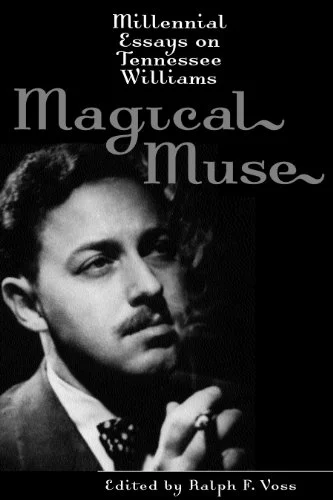
Williams’ ties to UA Theatre & Dance through Gallaway and his southern heritage are what drew third year MFA Directing candidate Raines Carr to The University of Alabama. Williams was born in Mississippi and spent most of his life traveling around the South. Many of his plays are set in cities like New Orleans, Memphis, or even gulf coast towns near Mobile. “I first encountered his work as a teenager in need of direction,” says Carr discussing how Williams’ plays have influenced and motivated his career. “I am always taken aback with wonder, astonishment, and disbelief that one man could feel so deeply… and articulate it in the form of theatre.”

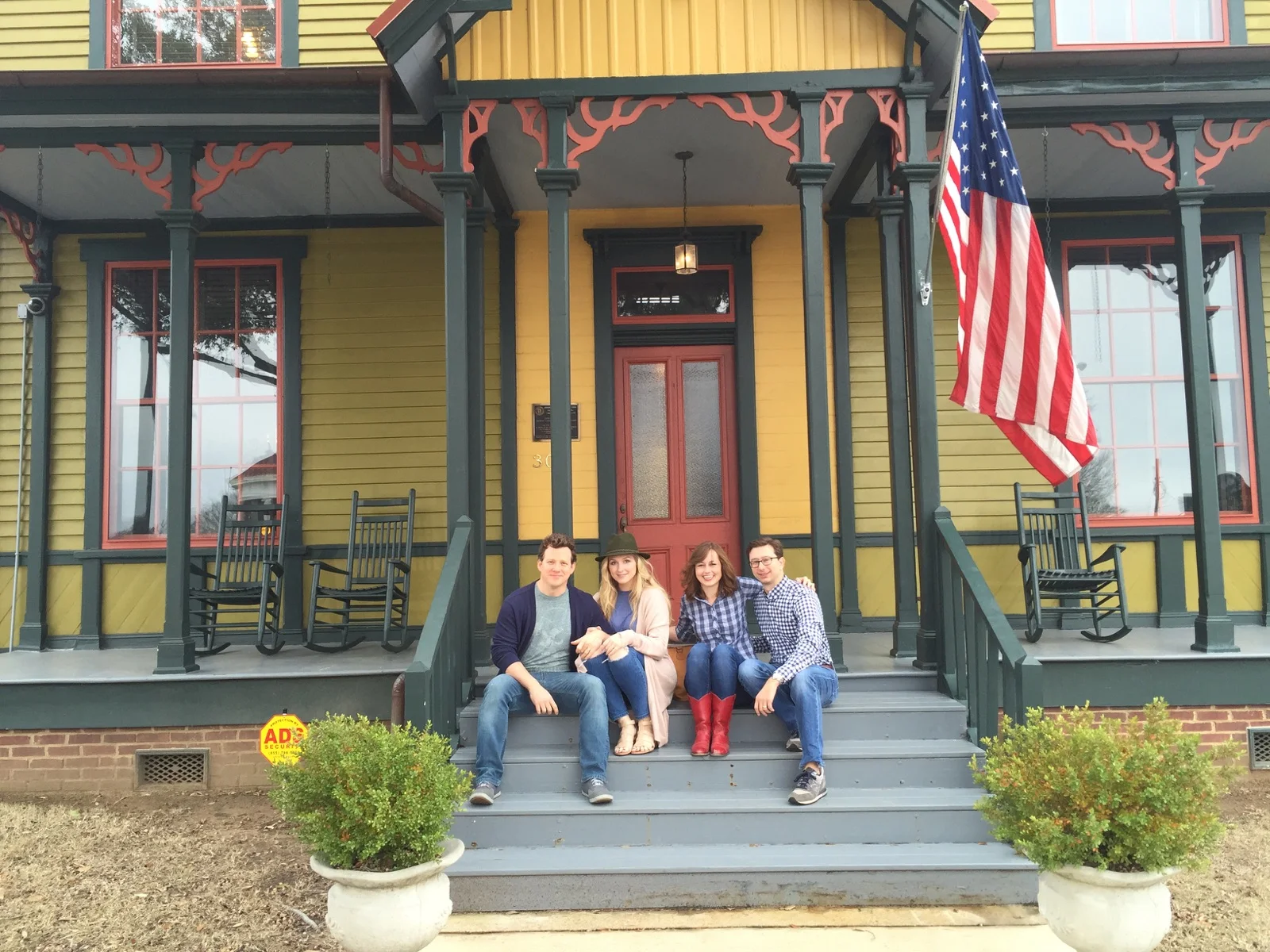
During the rehearsal process for The Eccentricities of a Nightingale, Carr visited Williams’ hometown of Columbus, MS with lead actress Chelsea Reynolds and their spouses. With the help of literary scholar Steve Pieschel, they toured the famous “Weeping Angel” tombstone in the historic Friendship Cemetery and the old Victorian home that served as the rectory for St. Paul’s Episcopal Church where many scenes in the play take place at the rectory.

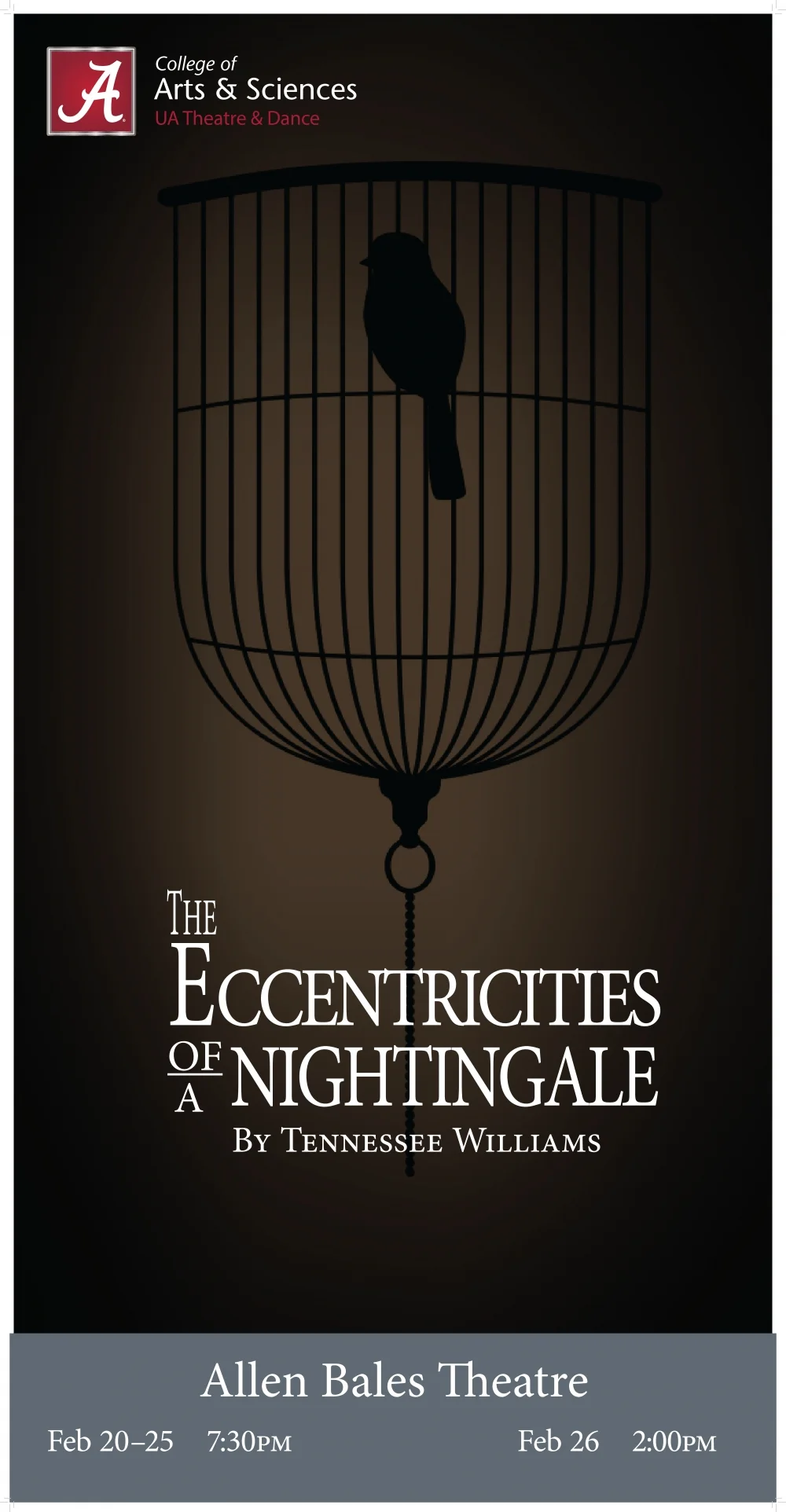
The Eccentricities of a Nightingale runs February 20 through February 25 at 7:30PM and February 26 at 2:00PM at the Allen Bales Theatre. Tickets are $10 and can be purchased in the lobby of Rowand-Johnson Hall, by phone at (205) 348-3400 or online at theatre.ua.edu.

For a full performance and event calendar, more information, and to sign up for a free e-newsletter, visit http://theatre.ua.edu.

CW Article: by Raines Carr

UA Theatre to showcase Tennessee Williams play

By Christina Ausley | 02/19/2017 9:19pm

This week, UA Theatre and Dance will present a play that's a little more "eccentric."

Set in Mississippi just prior to World War I, "The Eccentricities of a Nightingale" features a key figure, Alma, who struggles with her own concept of self, freedom and courage. The play brings to light the fear of obtaining true individuality among a relatively conformist society and subtly brings the audience along for the ride.

Raines Carr, a graduate student and the play’s director, has decided to bring the work to life this season.

“This play is about what it’s like to be on the periphery of society, and to be one of those eccentric people that doesn’t completely fit in,” Carr said. “It shows you there is a full life for you, even if it’s not the ‘normal’ one everyone thinks you’re supposed to have.”

The play is relevant to almost any college student and, really, any individual who is willing to put themselves in the audience, Carr said. The story aims to abolish preconceived notions of both the universe and the categorization of oneself in society. Carr selected "The Eccentricities of a Nightingale" because he believes it not only sets the actors free, but also the audience.

“We’ve all been put in this little box like that of Alma in the play,” Carr said. “At 18 years old, you go away from home, and you realize, ‘Wait, this box doesn’t fit me. In fact I’m nothing like this box. I have to figure out who I am, and I need to free myself to do the things that I want to do and be who I want to be.’”

Chelsea Reynolds, a third-year MFA actor, will play the star role of Alma as her seventh performance before graduating in May.

“Alma has this sense of gallantry and courage and forwardness in this time,” Reynolds said. “However, I think a lot of it has to do with finding this gallantry within yourself and breaking yourself out of this prison of your own making.”

Though Reynolds has taken part in numerous other big performances, and Carr has acted in and directed shows for close to 25 years, they both believe this may be their toughest show yet.

“This is the hardest role I have ever played and might ever play,” Reynolds said. “In eight of the nine scenes I perform in, each scene is like an entire play because the stakes are so high, and every scene is an emotional arc.”

It is not often a Tennessee Williams play like "The Eccentricities of a Nightingale" is performed live, and many English and arts students at The University of Alabama have taken note of this rare occurrence.

“Tennessee Williams doesn’t just know how to write, he knows how to write well,” said Maddie Sanders, a sophomore majoring in English. “I’m really looking forward to this performance because it's recently been rediscovered for its dramatic look into the life of an outsider.”

With the cast and crew putting in close to thirty hours of in-theatre work every week, Carr and Reynolds hope to put on an emotionally-charged performance for UA students and Tuscaloosa residents unlike anything they've seen before.

“This is an experience you are not going to get watching a television show or watching a film,” Carr said. “There’s something about the liveness of the theater in this particular play, and the liveness of the emotions of this play and the way that we have created the world. This will be something you have not seen before live.”

Shows will begin Monday, Feb. 20, and tickets can be purchased online through www.ua.tix.com

Original article posted here.