Director's Note for The Eccentricities of a Nightingale by Raines Carr

Director’s Note for The Eccentricities of a Nightingale

ec·cen·tric·i·ty – unconventionality, deviation of a curve or orbit from circularity.

“What is straight? A line can be straight, or a street, but the human heart, oh, no, it's curved like a road through mountains.” – Tennessee Williams (A Streetcar Named Desire)

Tennessee Williams- beyond being one of the writers that defined American Theatre- was an eccentric, an outcast, one of the lost and lonely, one of the dejected, even if only in his own mind. He also happens to be my hero. I first encountered him as a teenager in need of direction. A community theatre production of A Streetcar Named Desire changed my life: as Blanche descended, so did I. A 15-year-old boy was altered that night, finally understanding and initially discovering his purpose. I knew where my life needed to go and I have spent that last 26 years trying to recreate the feeling of that night in my work. I am always taken aback with wonder, astonishment, and disbelief that one man- one small, soft-spoken man- could feel so deeply and articulate it in the form of theatre so powerful that it still pulses at the foundations of our national dramatic sensibility. Mr. Williams has created some of the most recognizable and effective plays in the American canon. It is a pleasure to read and work with his inimitable dialogue. It is a lifelong dream of mine, which has come true tonight, being able to present this production to you.

The Eccentricities of a Nightingale is a reworking of a previous, more popular piece called Summer and Smoke. Summer and Smoke helped spur the Off-Broadway movement in the early 1950’s and is a great testament to the poetic melodrama of its day. It is rife with passion and longing. You can feel the hot summer nights seething from the stage. Alma (the main character) is a minister’s daughter in love with the boy next door. We find that she is sometimes willing (and sometimes unwilling) to share that passion with him. She journeys from prude to would be paramour. The play still resonates, though the drama can be a ‘bit much’ for a savvy, modern, theatre-going audience. Williams was known to tinker with his work for decades. Alma came from a short story published in the early 1940’s and he never felt that he did her justice until he wrote Eccentricities. This final version of Alma’s ennui in small town Mississippi is much subtler and more personal than any previous version. The emotional life is pared down to its core and it becomes a powerful statement on loneliness and acceptance. Alma is not here to fall in love with the boy, she is here to set herself free.

I strive in all my work, for good or ill, to present art free of constraint and cliché. I want you to live with Alma and others in this play for a while and walk a mile in their shoes. We sometimes get the best view projecting outside of ourselves and considering another’s circumstance. Doing this has taught me more about how to be a human than any other mode of experience. I don’t want you to feel obligated to care for the characters you see tonight. I just want you to be open and let them give you this story that Mr. Williams has so lovingly crafted: a story of the outsider understanding that there is a life in the margins. A full life. A life worth rejoicing. We all feel like outsiders in most situations, I know I do. We fake our way through most of our obligations. We are the lost and the lonely, but we will find the connection. We just need to take a leap into the unknown and see where experience takes us. Take what is given and pass it on. Art is working through our emotions. Our stories give us meaning. This particular story devastates and revives me on a daily basis. I hope it also gives something special to you.

“Through our craft, we will cultivate a more empathetic and understanding society by revealing intimate truths that serve as a forceful reminder to folks that when they feel broken and afraid and tired, they are not alone.” – David Harbour
The Eccentricities of a Nightingale by Raines Carr

The Eccentricities of a Nightingale
by Tennessee Williams
Directed by Raines Carr

Feb 20 - 25 at 7:30pm
Feb 26 at 2pm

Revamped from his earlier work, Summer and Smoke, Tennessee Williams brings us to pre WWI Mississippi where, Alma Winemiller, the minister’s daughter, is desperate to win the love of a young doctor, despite their complex social situation. Can they overcome their struggle and find happiness or will they be forced to be apart forever?

Tickets: https://theatre.ua.edu/productions/nightingale/

Falsettos review by Raines Carr

Originally published here.

REVIEW: Musical accurately captures melodrama of love

By Mark Hughes Cobb

A musical that starts with a song titled "Four Jews In a Room Bitching" -- an alienated teenage boy (Kyle Van Frank); his father Marvin (Matt Gabbard) who's just left home to be with a gay man (Whizzer, played by Peyton Davis); and the therapist Mendel (Daniel B. Hulsizer) -- probably won't showcase kick lines and bring-down-the-house choral numbers.

But that's not to say director Raines Carr's production of the James Lapine and William Finn musical "Falsettos" lacks energy, variety or visual appeal. Within the confines of the Allen Bales Theatre's thrust stage, and utilizing colored building-block props, aided by a chair, chess set or racquet here and there, Raines and crew crafted a minor spectacle, fitting for this comic drama about the families we have clashing with the ones we create. The blocks pile up, line up, break down, spread out, clutter the center and give way to make walls, in a tidy metaphor underlining the now you see 'em, now you don't, mix-and-match threads connecting the four Jews, abandoned wife Trina (Megan Kelly) and in the second act, next-door lesbians Dr. Charlotte (Shaffer Diebolt) and Cordelia (Megan Hill).

The set is all the more remarkable being the work of Andy Fitch, who prefers massive stages. But it's simple and effective, much like the almost-invisible costume work by Kati Stankovich, reminding us yet again that the '80s are not worthy of fashion nostalgia. Russell McKinley aids in that flexibility with the -- again, almost-invisible -- kind of work that illuminates without calling attention to itself.

The cast, all undergrads, does a remarkable job of deep engagement, where audiences forget they're watching kids who weren't even born when this work -- consisting of a pair of one-acts, written and performed a decade apart, then brought together for a full-length production -- was written and set. One of the harder jobs for an actor is playing older, more mature; playing younger's typically less demanding, because they've been there. Some actors hear "You're playing a guy twice your age" and fall into a stoop, cracking their voice and walking like the near-dead. From 20, 40 can look ancient.

But Carr's got it in hand. The kids show the stamina and beauty of youth -- aside from rare dialogue, it's two-plus hours of singing, dancing and emoting -- but easily pass for adults, with adult fixations.

Sophomore Van Frank goes another direction, beautifully capturing an awkward kid just shy of his bar mitzvah -- in the second act, the blended families struggle to plan his big day -- with a beguiling fumble toward understanding matters he's forced to deal with by sometimes over-sharing adults. Van Frank renders heartbreaking and hilarious moments, as the only thing all the grownups can agree on.

Gabbard's Marvin unravels and expands, contracts and explodes, a bundle of anxiety and neuroses. He only gives up therapist Mendel when his ex-wife falls in love with and marries the guy. He should've found another. Marvin's journey is torturous, from entirely understandable to maddeningly immature. The heart wants what it wants.

His lover Whizzer threatens to become the stereotypical freewheeling gay guy in the big city, but Davis brings an earthy warmth, even in moments of biting truth or cutting wit, that leads the finale to its crushing end. Hulsizer grabs the biggest belly laughs, and there are many, with infectious sunniness and devotion: Mendel has to tread a lot of fine lines. Kelly's work is just lovely, from consternation to confrontation to cooperation; with her son Jason, she's the most aggrieved, and yet the adult, as the show closes, probably most fully realized. Deibolt and Hill, with stage less time, make quick decisive marks as more than just pals, but add crucial ingredients to the mix.

It's a musical with sardonic wit, a drama with heartbreak, a melodrama of love (but ain't love always that way?) and a coming-of-age tale. It's a bit like "Rent" if characters grew up and started families. The mood shifts song to song, like an old unformatted FM station, with each piece is its own world. But with Carr, cast and crew capably in charge, solid forms emerge from abstracted pieces.

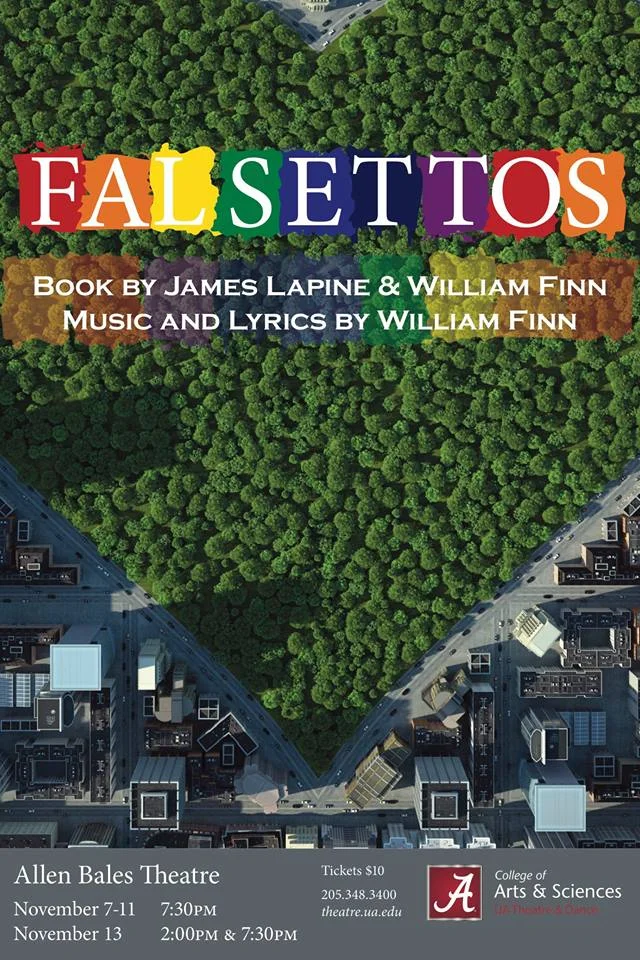
Falsettos Opens Tonight! by Raines Carr

This show will run from Nov. 7 - Nov. 11 at 7:30pm and Sunday Nov. 13 at 2:30pm and 7:30pm in the Allen Bales Theatre on the Campus of the University of Alabama.


Tickets available at:

http://theatre.ua.edu/productions/falsettos/